Wk36 MacroTechnicals - Warsh, Rinse, Repeat: Inflation Still a Problem
Warsh took AI disinflation off the table, said economy at full employment, put emphasis on inflation breadth and price stability being the predominant focus. This is a hike signal...
Calling a bluff on hikes
My initial read on Warsh's Jackson Hole speech was emphatically hawkish, and that he effectively signalled a rate hike. It has been interesting to see a range of opinions and particularly a good number of respectable X accounts believe Warsh didn't signal anything at all. A few examples of common themes I'm seeing in those no-hike views:
A popular belief is that Warsh won't hike before midterms. Perhaps a bias that is blinding them to the subtle signals in Warsh's speech?
Special Situations (ex-Goldman)
Unlikely that Warsh hikes right before the midterms, Trump would go ballistic, but who knows... 71% probability for October and 90% for December is ridiculous (on X)
Calling a bluff on the market's hawkish take. Talking his short USD book while seeing AI productivity gains being deflationary.
Andreas Steno Larsen
I love the fact that everyone thinks Warsh has forward guided a rate hike in September now lol (X). He didn’t really deliver the productivity speech I had hoped for (X).
Neil Dutta also in the camp of AI being disinflationary.
Neil Dutta at RenMac
I'd argue that Warsh didn't really lay the groundwork for a rate hike. He's catching up to the rest of the FOMC, walking the ground they already put down. I didn't see much discussion of a productivity driven disinflation story today. (X)
I've never taken Neil Dutta's commentary lightly, but I find myself in strong disagreement with his posts. Firstly, on his not seeing much discussion on productivity driven disinflation, he is incorrect. Warsh dedicated a good portion of his speech to those questions but conceded that the degree and timing of those impacts are unknown, highly uncertain, that it will be studied, and that inflation running uncomfortably above target should in the meantime be the predominant focus, Warsh has not only addressed AI disinflationary impacts, but has clearly stated it as being not relevant to policy discussions, today. As much as I respect Neil, I think he is being blinded by his own book or views here.
And to finish with a bit of irony...
Lyn Alden:
“The Fed needs clear market signals, as unfiltered as possible.” - Kevin Warsh, while Scott Bessent is running around doing Treasury interventions (X)
Of course they can be right. That Warsh is politically or even familially motivated not to hike, that AI impacts will prove a tightening to be a policy mistake. But I will highlight some significant points of the speech to outline my case below.
Dissecting Warsh's Speech
AI productivity "have no bearing on decisions we make in the current policy conjuncture..."
Will the application of AI cause a significant, sustained rise in productivity across the economy? And if so, when?
Will token usage be complementary or competitive to labor?
Will the next generation of AI models demand even greater capital intensity, or will the models themselves help devise a capital-light solution?
Among the other yet unknowns is the resulting market structure. It's not obvious where the returns on capital will land or on what timescale. Early on, how much of the surplus goes to owners of scarce assets—AI labs, chipmakers, energy producers, and cloud providers?
Over time, how much of that value accrues to businesses and consumers? What are the broad implications for workers and for the employment side of the Fed's mandate?
Likewise, we don't yet know the equilibrium price of the tokens. Might there be a heterogeneity of tokens, such that growing sums will be paid for access to the best models at the frontier?
Will token prices for older models fall to the level of their marginal cost?
We will be thinking through these matters with the help of a task force on productivity and jobs. My early check-ins with the leaders of that task force, and the four others, have been encouraging. To be clear, though, their recommendations will come later and have no bearing on decisions we make in the current policy conjuncture. But I believe that for future policy challenges, this intellectual investment today will leave us far better prepared.
Rate setting is the main policy tool.
interest rates are the predominant tool to achieve the dual mandate. Unconventional policies to spur economic activity may suit genuine crises but should otherwise be used sparingly, if at all.
Fed relies on clear market signals. Removing forward guidance avoids contaminating market signals needed for better decisions.
I believe when policymakers make quasi-commitments on interest rates through the cycle, we inhibit our own freedom to make the right calls when it's time to decide.
The Fed needs clear market signals, as unfiltered as possible... from market internals... the level and change in asset prices across sectors... the prices and trading volumes of Treasury securities... the foreign exchange value of the dollar... the cost and availability of credit... and the price of a broad set of commodities.
Reiterates 2% PCE inflation as the main 'fixed' target. This removes all doubt Warsh would use other measures to 'politically' avoid hikes.
Fed's price-stability objective of 2 percent, as measured by the PCE price index, is a firm, fixed target. Price stability is not self-executing, nor is inflation necessarily mean-reverting. It is the Fed's job to deliver stable prices.
Keeping inflation under control is a prerequisite to maximum employment.
Achieving both sides of our mandate over the medium term is not an either/or proposition. I do not believe that the Fed's dual mandate works at cross-purposes. After all, high inflation itself is very harmful to economic prosperity.
Economy holding up remarkably well to shocks.
For my part, today I am impressed by the overall performance of the economy, which appears to have strengthened. One indicator of strength is how well an economy holds up to shocks. On that score, both Main Street and Wall Street have been remarkably resilient.
Exceptionally strong capex growth implies strong future growth. Recognises strong profit growth and future expectations.
Business capital expenditures—the seed corn of future economic growth—are rising rapidly. The four-quarter change in investment in equipment and intangibles has been around 9 percent, its highest growth rate since 2021.
S&P 500 profits have grown by more than 20 percent over the past year. Profit margins are quite elevated, relative to history. Overall equity market volatility is low.
Expectations for growth in both capex and corporate earnings are running quite high.
Credit conditions are easy, financial conditions are not restrictive.
Credit spreads on corporate bonds and leveraged loans are near the low ends of their historical ranges and issuance volumes have been quite strong this year.
July SLOOS on Bank Lending Practices tell us that standards for commercial and industrial loans are on the easier end of their historical range. That helps explain the growth we've seen this year in those loans. Credit and loan markets are showing few signs of policy restraint.
Certain sectors—like housing and agriculture—are showing strains. But, on balance, I would be hard pressed to describe broad financial conditions as restrictive.
Consumption is healthy despite the shocks.
Real consumer spending has been healthy despite the shocks, increasing more than 2 percent over the past four quarters. Combining consumption with the brisk investment we've observed, private domestic final purchases (PDFP) has also risen. PDFP has increased at a pace of nearly 3 percent so far this calendar year. That's a measure that typically carries more signal than gross domestic product, and the trend here too is positive.
Current labour market is consistent with maximum employment.
When labor supply is barely growing, monthly job gains are naturally going to run low. I believe the labor markets are consistent with full employment.
Labor markets are quite stable. The jobless rate, at 4.1 percent, remains low by historical standards and has not changed much for a couple of years. Unemployment claims, on a four-week average—an empirically robust real-time indicator—are near their lowest level in decades.
Price-stability should be the predominant focus.
But on the price-stability side of our mandate, the numbers are more concerning. The Fed's preferred measure of inflation, the 12-month change in the PCE price index, stands at 3.7 percent, while the six-month change is 4.1 percent. The comparable measures from the consumer price index (CPI) are also elevated, as are the core measures of both PCE and CPI inflation. None of these measures are perfect, but they all tell a similar story: Inflation is running above our 2 percent target. So the Fed's predominant focus right now should be on prices.
Underlying inflation is key, and recent progress has been modest.
The job for policymakers is to capture underlying trend inflation—that is, the generalized change in prices in the economy, unaffected by idiosyncratic factors. We want to gauge whether underlying inflation is rising, falling, or stuck in place. We also want to understand not just the direction of travel, but also the speed. Each of these broad inflation measures has fallen significantly from their 2022 heights. But progress over the past two years has been modest.
No evidence underlying inflation trends have 'meaningfully' improved.
And while this summer's PCE and CPI readings were better than expected, they do not tell me that underlying trends have meaningfully improved.
Weaker wage growth not a reliable indicator of future inflation.
The data also show moderate wage growth. But in tracking underlying inflation, wage growth has not proven a reliable indicator of future inflation for a very long time.
Breadth is important in gauging underlying inflation.
To try to gauge underlying inflation, I find it instructive to disaggregate the 199 individual components of the PCE price measure. Over the past 12 months, 54 percent of goods and services in the PCE basket showed price increases above 3 percent. This is well below the post-pandemic highs of about 77 percent, but it remains well above the level of 32 percent in the two decades that preceded the pandemic.
Looking over just the past six months, the conclusion is similar: Of goods and services in the PCE basket, 49 percent showed annualized price increases above 3 percent. Again, this is well below the post-pandemic highs but still quite elevated.
Summing up the Speech
AI productivity/disinflation is not a policy factor
Warsh could not have been more clear on this, saying it has "no bearing on decisions we make in the current policy conjuncture...".
Logic of economic assessments is Hawkish
Economy absorbing shocks well, capex and profits point to expansionary momentum, consumption healthy, credit easy, and financial conditions are not restrictive.
Failing on price-stability while achieving on maximum employment
While mentioning inflation being above 2% should be the "predominant focus", it was particularly telling that he considers the current labour market as being at full employment. The message couldn't be clearer - the economy is at full employment, but inflation is not at target. This, to me, is the signal for a hike.
Price [In]Stability
PCE IS WELL ABOVE TARGET
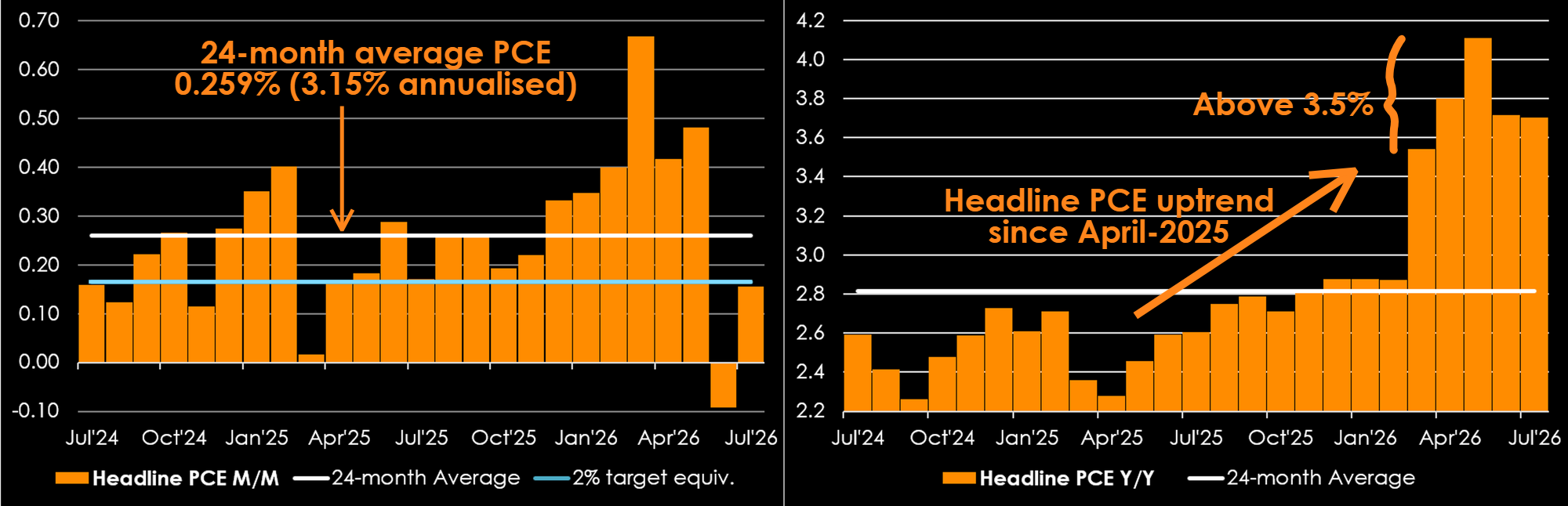
PCE has been averaging 0.259% the past 24 months or an annualised pace of 3.15%. 1.15ppts above Warsh's clearly articulated '2% as measured by the PCE price index as a firm, fixed target'. Recent months have slowed but the broader trend remains up and a very long way from target.
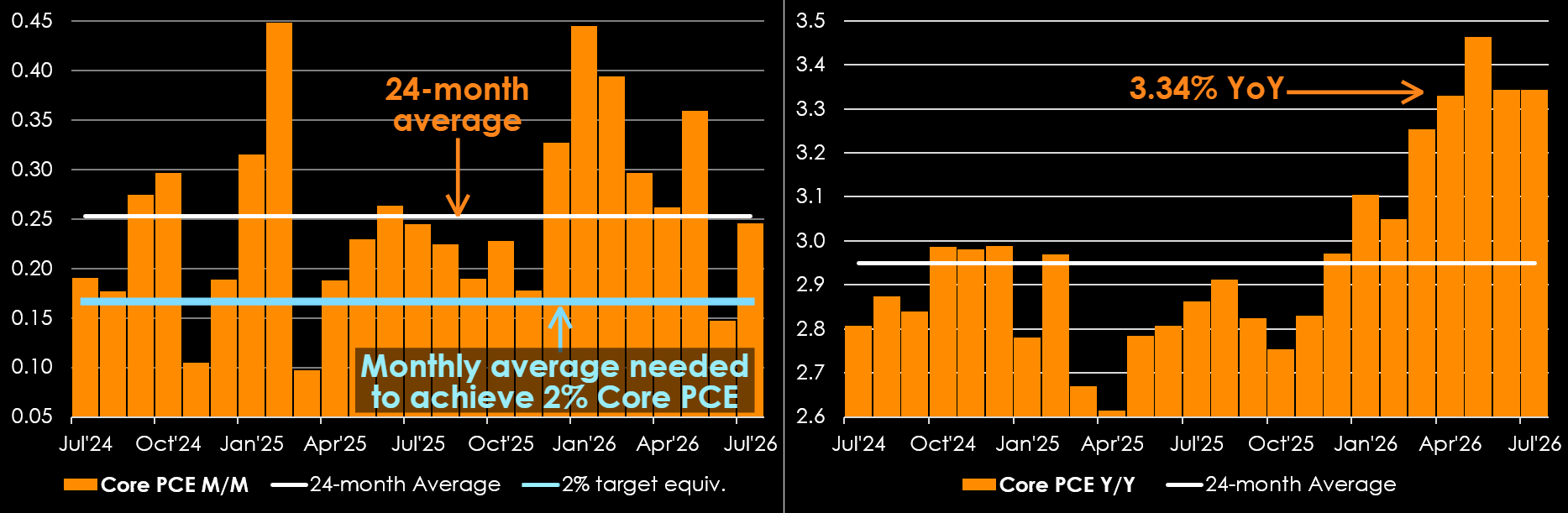
Similar inferences can be made of core PCE. Monthly core PCE has been averaging 0.88% above where it needs to be over the past 24-months, and the 12-month average has been moving higher so far this year.
INFLATION BREADTH HAS BROADENED
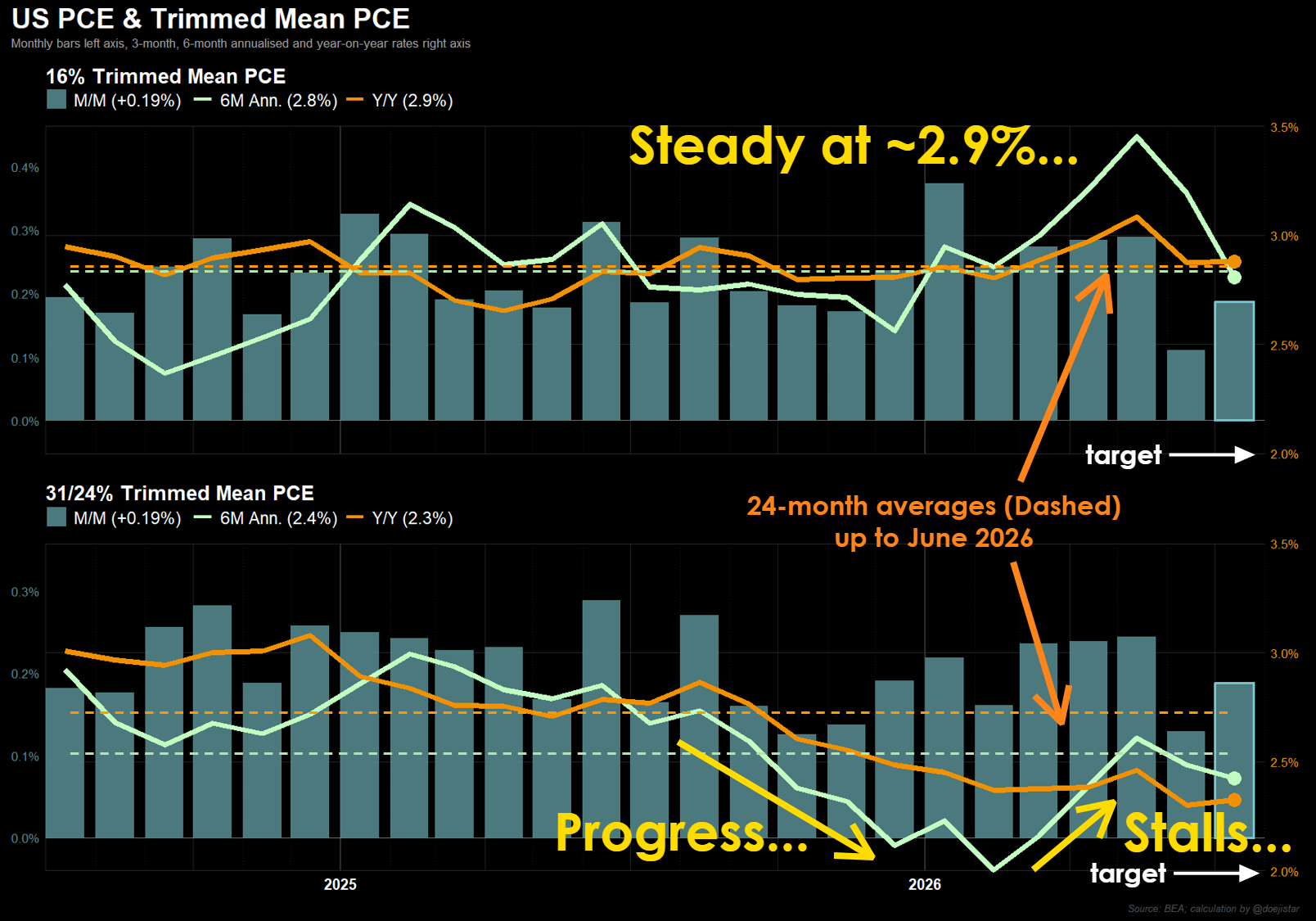
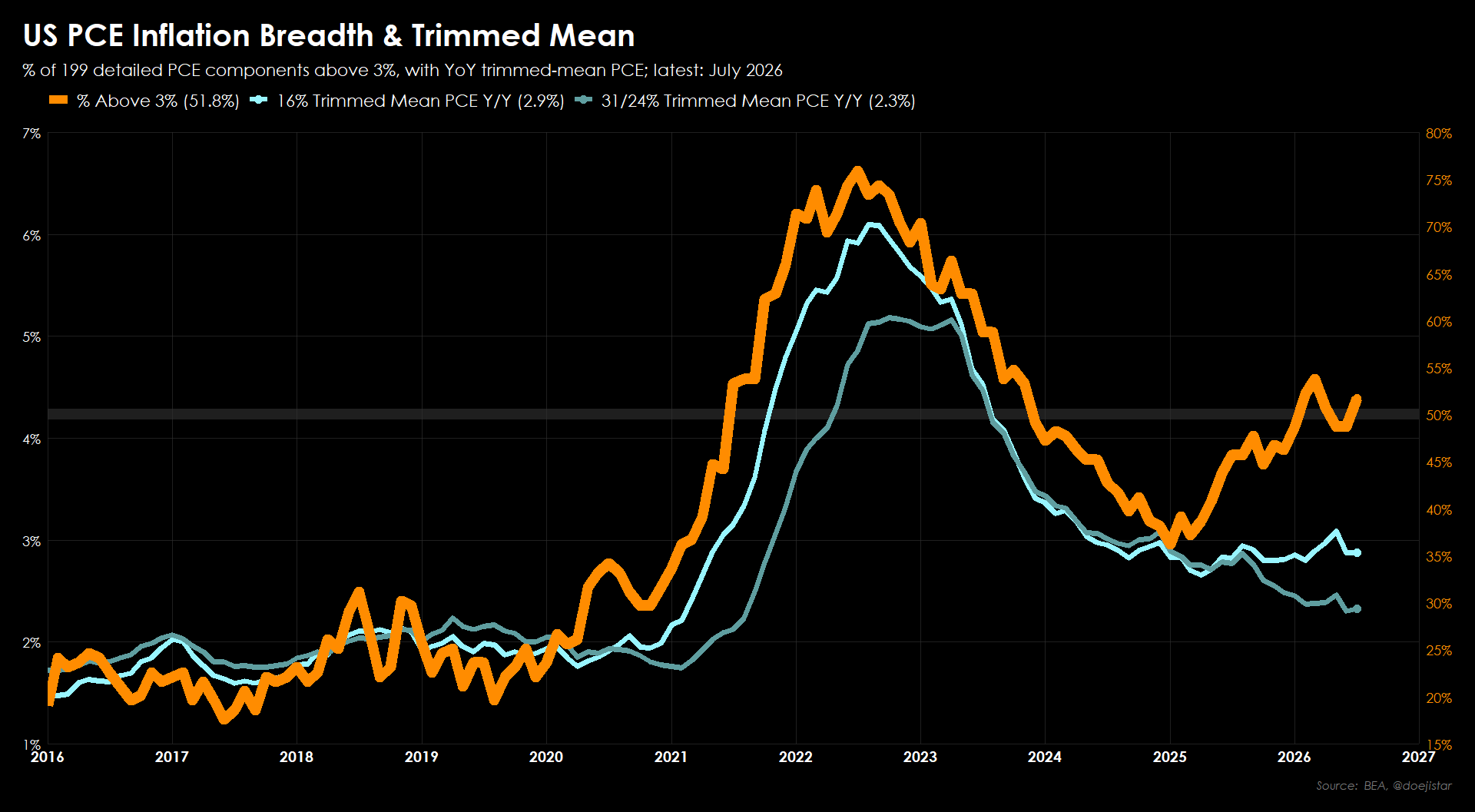
Warsh said that "while this summer's PCE and CPI readings were better than expected, they do not tell me that underlying trends have meaningfully improved." YoY 16% trimmed-mean is little changed and hovering slightly above the 24-month average at 2.9% signalling no progress over the past 2 years. The so-called Dallas Fed trimmed-mean (31/24%) showed initial progress of returning to 2% at the start of the year but that progress has since stalled and reversed.
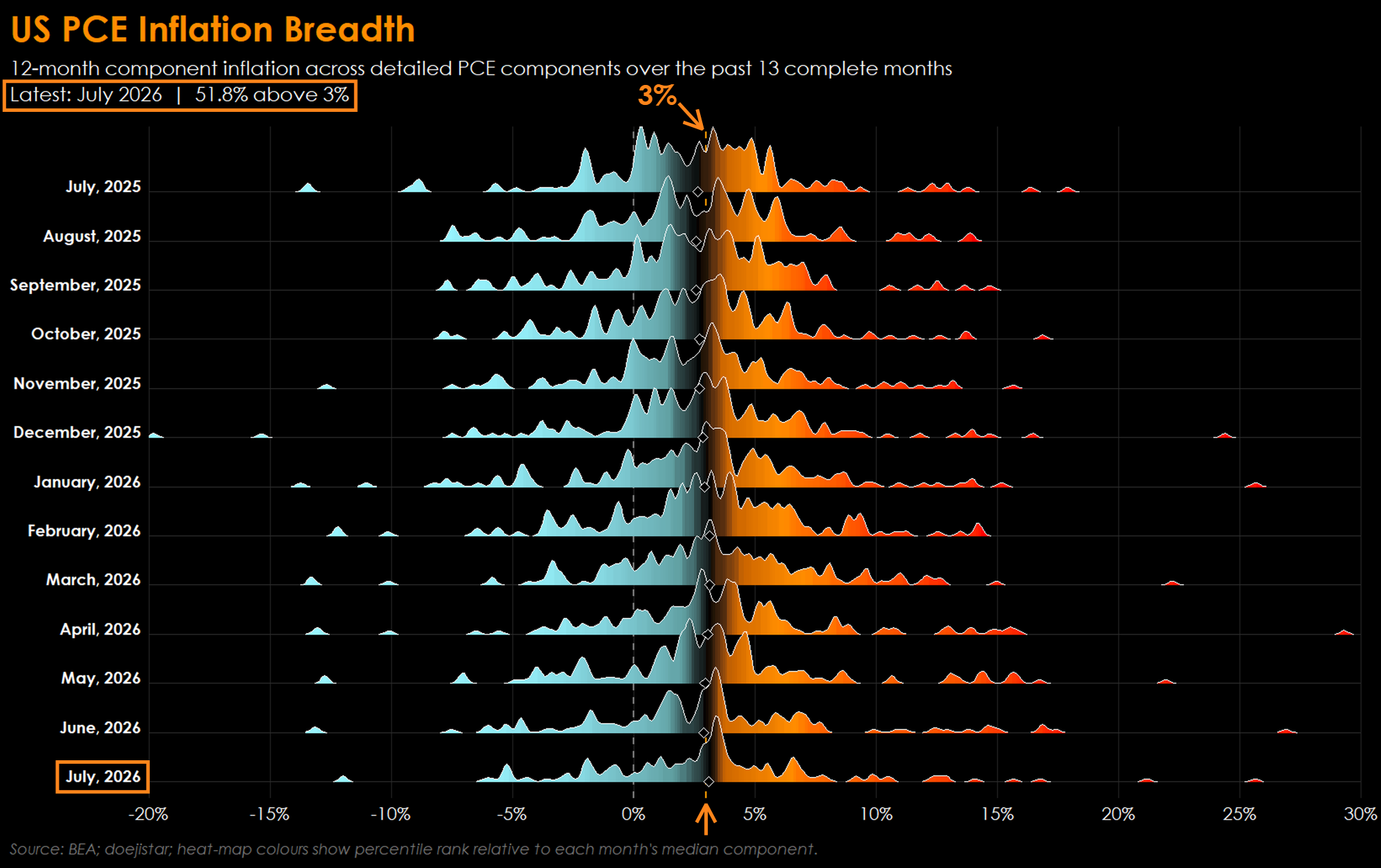
Looking at inflation breadth, which Warsh went into some detail to flag as being an important gauge, the below shows the YoY rates for all individual PCE components over the past year. Some notable observations:
- Distribution has shifted right
The central mass was closer to 2% a year ago but the median area (in black) has drifted above the 3% line, meaning a majority of components (now 51.8%) are seeing greater than 3% inflation. - Low-inflation tail has contracted
Left tails (in blue) have thinned compared with the second half of 2025 with fewer components in particular clustered around zero to 2 percent area. - Right-tail has become more persistent
After drifting centrally in 2H of 2025, the right tail has expanded outwards in 2026 with more persistence being displayed during the latest months and July in particular showing renewed broadening.
Warsh is right to look at this as a basis for where policy should be. It is, in his words - a good 'gauge' of underlying inflation. As the below shows, it has been a good lead on trimmed mean PCE which itself is considered a good underlying inflation proxy.
CLEAR-CUT SIGNAL
Given that Warsh emphasized price-stability' while considering the economy to be at full employment, I think I have laid out a convincing case that Warsh has signalled a rate hike. Further, for a man that wants to reveal very little about his policy intentions ahead of time by removing forward-guidance, I think that makes these signals even clearer.
For our premium members, we've done well to be trading around USD longs and shorts on assets that have thrived on the debasement narrative such as BTC and Gold. We'll discuss a little further about how the Warsh speech solidifies our thematic trading views and biases, as well as the thematic trades beyond the debasement fade. If you enjoyed reading this post, subscribe and consider upgrading to premium to engage with us and our trade ideas in real-time.