Wk22 MacroTechnicals - Bullish Optics, Bearish Reality
AI and Iran deal optimism collides with rising inflation risk and tightening fincon
Markets are becoming increasingly trapped between the crosswinds of optimism and economic damage already being done. AI capex enthusiasm and the prospect of a US-Iran MOU have helped sustain market optimism but the economic effects of war are already feeding into a stagflationary backdrop that has pushed the macro regime in a stagflationary direction - one of rising inflation risks and a less supportive policy outlook. Risk assets may still be able to rally in that environment, but it would no longer be doing so in the disinflationary easing regime that helped to carry them for the good part of the last year.
This week, we start by focusing on how the US-Iran game is playing out as these narratives also influence our second focus discussion on macro regimes, and how to think strategically when trading the markets.
US-Iran Deal
SHIFTING GAME DYNAMICS
Despite the many contradictory messages coming from both Trump and Iran, there has clearly been some momentum toward an interim MOU where both sides appear open to a sequenced framework built around war cessation, Hormuz access, limited economic steps, and only later time-limited nuclear talks. If agreed, that would mark an important change in game dynamics: from a coercive deadlock to a phased bargaining process, and an important shift from the game we initially mapped out in March that pointed heavily to a state of attritional instability, and an extended war of attrition.
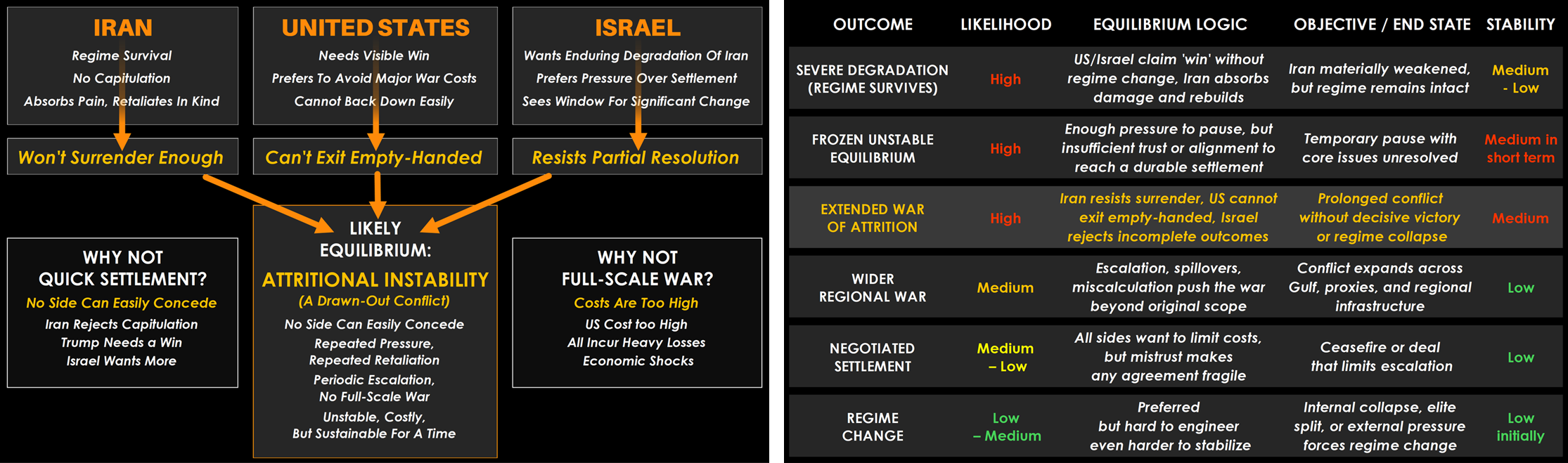
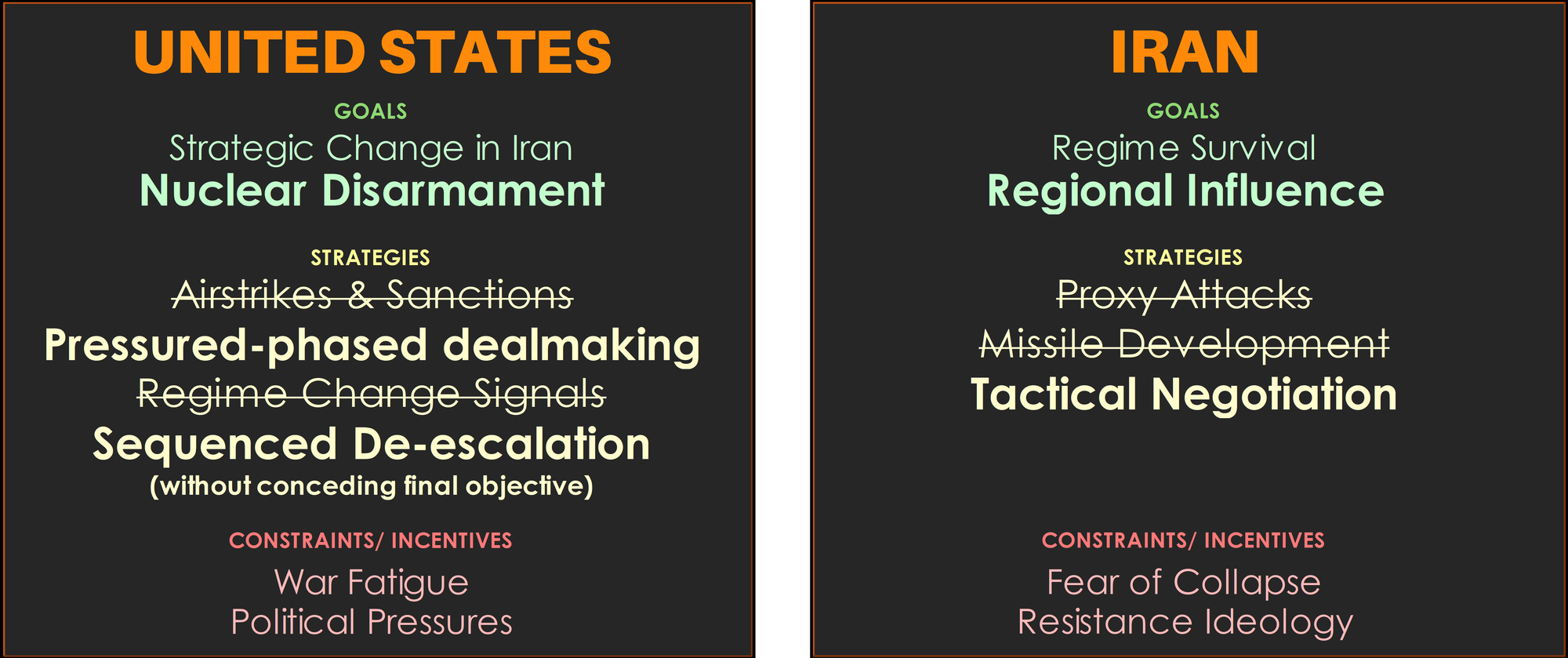
What's changed since then is a slight shift in focus on the core objectives, but mostly the strategy each side appears willing to use. On the US side, goals are weighted towards nuclear disarmament over regime change and strategy shifting towards deescalatory deal-making. On the Iranian side, regime survival remains a core goal but regional influence (leverage) has become the dominant motivation with strategy turning towards tactical negotiation.
PROGRESS
The shift in key-goals and strategies makes the game look less like a near-zero-sum confrontation, and more like a sequential-bargaining game that is easier to stabilise as not every major point of contention has to be resolved all at once. Core issues we mapped out around the end of March (middle column) proved a decent roadmap to understanding the conflict. It has been updated (last column) to reflect recent attempts on finding a pathway/framework to a deal. As a result, the negotiation timeline has become visible as opposed to being in a deadlock, while inducing movement and dialogue around the main issues.
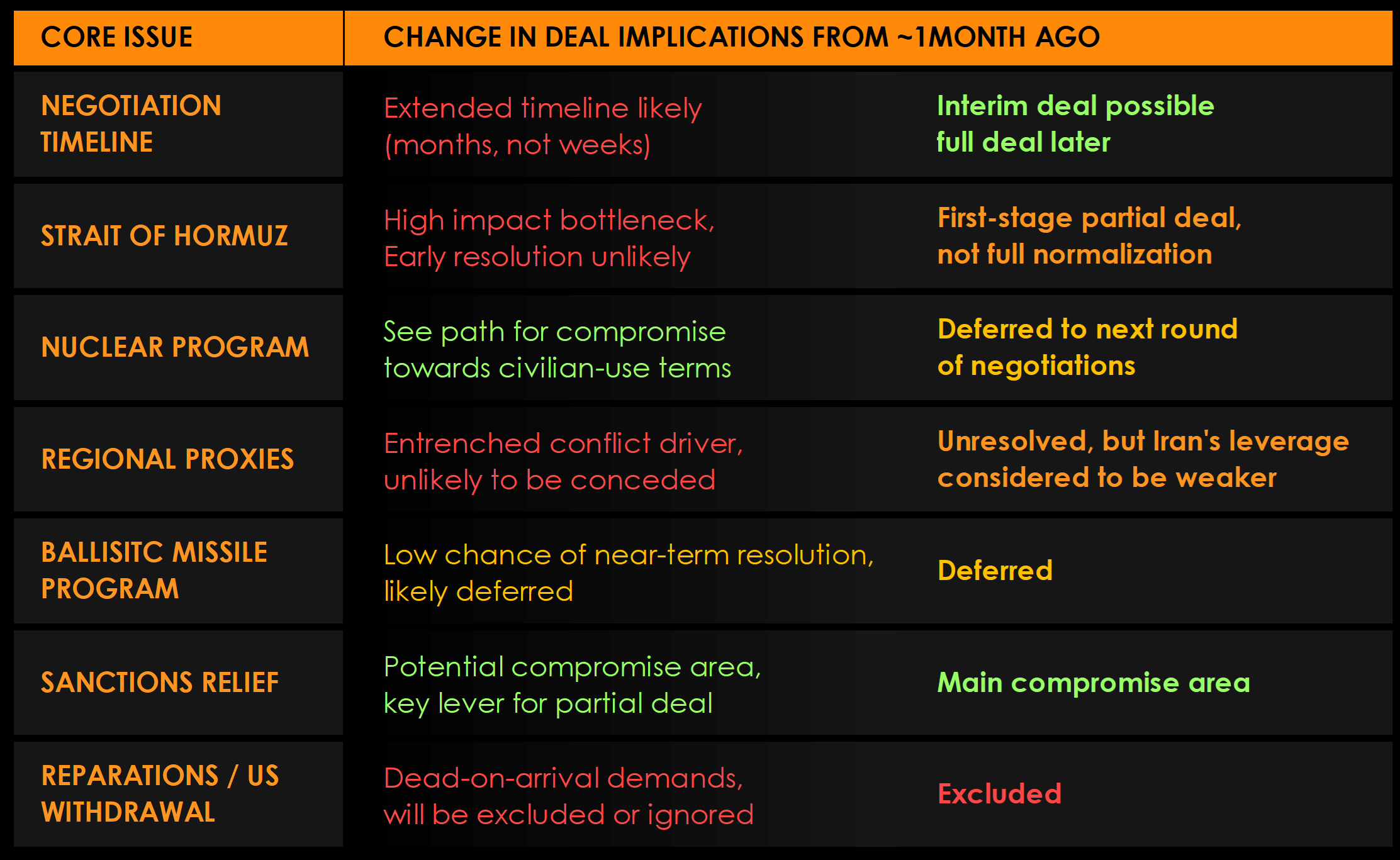
This is far from being a stable equilibrium however and one that can take many twists and turns as the bargaining is driven by leverage, by compromising on mechanics for now, but neither surrendering their core leverage and end-goals. Progress - yes, but not stable.
SHORT-TERM BULLISH RISK
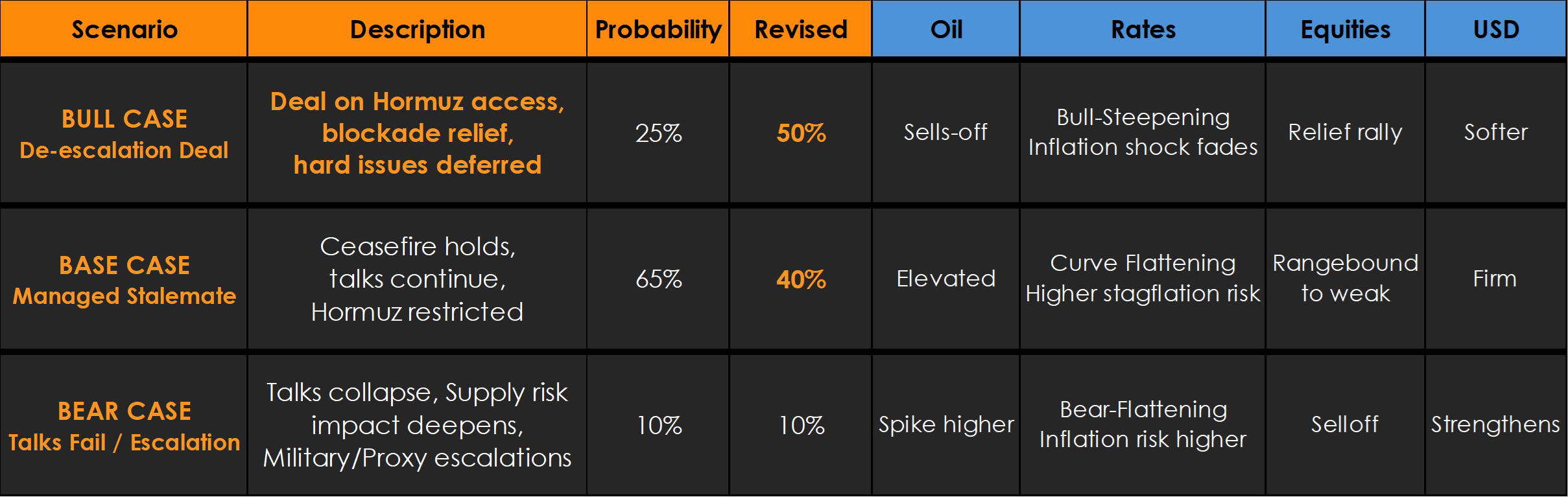
Those developments should be enough to sustain the deescalation narrative and the possibility of an MOU being agreed. As a result, I give the bull-scenario as carrying a slight edge at 50% for a deal versus 40% for a continued stalemate. My more subjective view however is that the truer odds are still something closer to the 25% deal and 65% stalemate that was initially assigned and that the revised odds are simply to reflect current narratives that may later change should an MOU not be reached over the coming weeks, for example.
LONG-TERM SKEPTICISM
Over the longer term, I still have a great deal of scepticism that the initial MOU would amount to a more durable resolution or a true end to the war because I think the US would have to make a large number of concessions that would effectively 'pay off' Iran to leave the SOH free to navigate and to abandon its nuclear ambitions; something I do not see Trump capable of doing particularly as he repeatedly lambasted Obama for essentially doing just that.
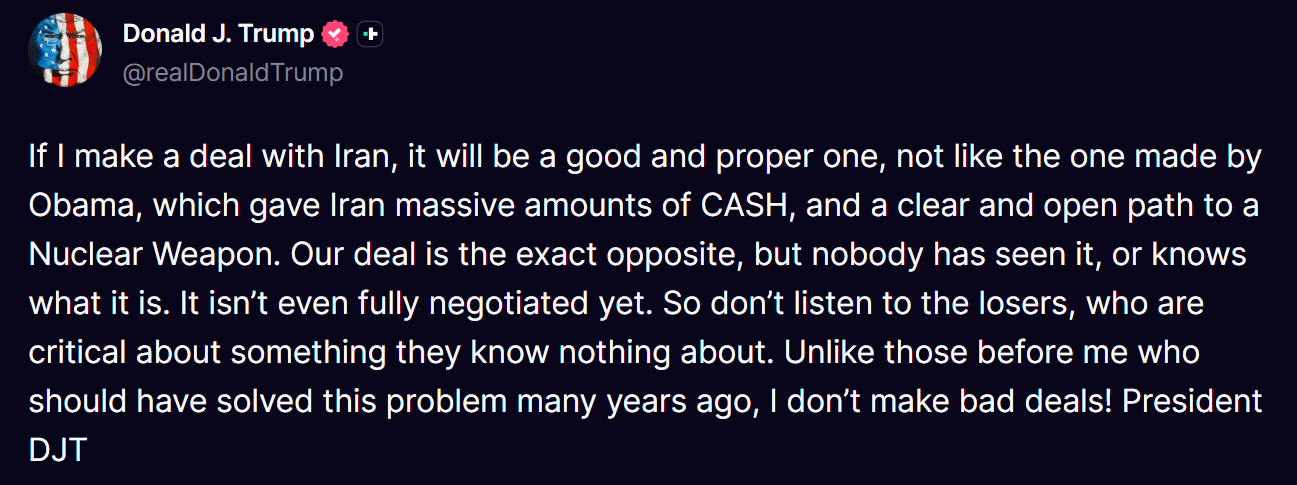
So while the near-term tone may have improved, the gap remains fundamentally wide. Trump has been explicit that an Iran without enriched uranium is a key end-goal. Iran by contrast has hardened their stance on the uranium issue, while its numerous statements and actions demonstrate their willingness and ability to wield as much leverage as possible knowing that it is Trump who is under pressure for a speedy deal and not themselves. For that reason, I do not see either side as being materially closer to a deal other than in appearance. Iran is likely to keep playing brinksmanship — dangling just enough possibility of a deal to keep Trump engaged, while withholding enough to drag talks out, raise the price, and make any agreement painfully slow if not practically unreachable.